
How it works
The Resolution Engine is split by a strict trust boundary:
- The control plane decides when to look. Chainlink operates it. It keeps the catalog of events and markets, tracks schedules, and triggers a resolution check when an event's resolution window opens. It sends the trust plane identifiers and rules only. It never sends results, and it cannot choose an outcome.
- The trust plane decides what happened. It is a CRE workflow that runs on a decentralized oracle network (DON). It fetches the evidence itself, requires agreement, and applies the market's rule. It is the only component that can produce an outcome.
Because the trust plane fetches its own evidence, a faulty or compromised trigger can, at worst, point the workflow at the wrong event. It cannot supply a result. The trust plane keeps no state of its own: every run receives what it needs in the trigger, and the control plane holds the catalog and history.
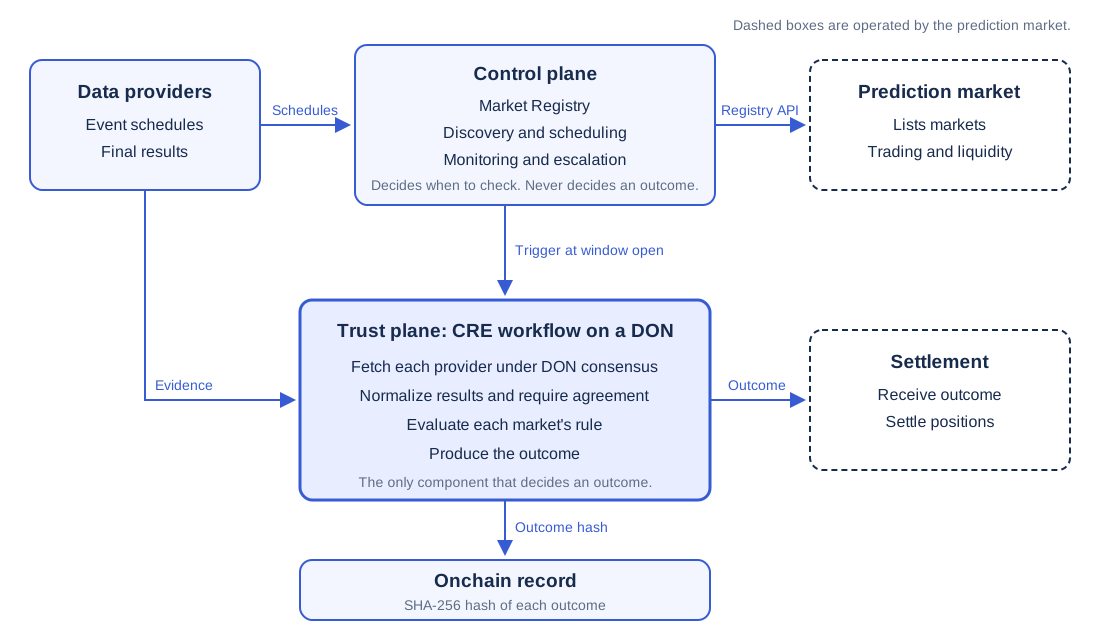
Components
| Component | Operated by | Role |
|---|---|---|
| Market Registry | Chainlink | Catalog of events and their markets, with stable slugs, resolution criteria, and event status. Your platform reads it through an API. |
| Discovery and scheduling | Chainlink | Finds new events from provider schedules, follows schedule changes, and triggers a check when each event's resolution window opens. |
| Monitoring and escalation | Chainlink | Tracks resolution progress and escalates failures to Chainlink operators. |
| Resolution workflow (CRE, DON) | Chainlink DON | Fetches provider evidence, requires agreement, and evaluates each market's rule. |
| Onchain record | Chainlink DON | Records a SHA-256 hash of each outcome in an onchain contract. |
| Outcome delivery | Chainlink | Sends each outcome to your platform, as agreed with Chainlink. See Outcome delivery. |
| Settlement | Your platform | Applies outcomes to positions. |
Following a full market lifecycle
This example uses the market "Will New York Yankees win?" on a Yankees–Orioles baseball game.
Listing
Event status: scheduled
- The market enters the registry. Chainlink adds the game as an event and attaches its markets, one per team. Each market gets a permanent slug, such as
cl-sports-baseball-mlb-260820-nyan-winner-nyan, and resolution criteria for traders: Resolves YES if the New York Yankees win according to SportsDataio and OddsPapi. - Your platform lists it. Your platform reads the market from the Market Registry API while the event's status is
scheduled.
Resolution
Event status: live, then final
- The resolution window opens. The event's schedule determines when checks begin. If the game is postponed, the checks move for every market on that event.
- The DON gathers evidence. Each node in the DON fetches every configured provider. The nodes must report identical data for each provider, so no single node can misreport what a provider said.
- Providers must agree. The workflow normalizes each provider's response into the same facts, such as runs per team. It accepts a fact only when enough independent providers report the same value and all of them mark it final. Until then, the market waits.
- The rule decides. With agreed final runs of 5–3 for the Yankees, the rule returns
YESfor the Yankees market andNOfor the Orioles market. Every market on the event is evaluated against the same agreed facts. The event's status becomesfinal.
If providers disagree or the rule cannot decide, the event becomes unsafe and nothing is delivered until the evidence supports an answer. See Trust and failure handling.
Delivery and settlement
Event status: final, then completed
- The outcome is recorded and delivered. The DON records a hash of the outcome onchain and sends the outcome to your platform as agreed. If your platform holds outcomes for a dispute window, the outcome is sent first as indicative.
- The outcome is finalized. After any dispute window, Chainlink delivers the final outcome. It reuses the outcome and evidence already decided; it does not fetch providers again. The event's status then becomes
completed. - Your platform settles positions under its own rules.
Market lifecycle lists every event status.
One market, many platforms
A market's slug identifies the underlying question, not one platform's listing. When several platforms list the same market, the engine fetches the evidence and decides the outcome once, then delivers it to each platform. Every platform receives the same answer from the same evidence.
Next steps
- Supported markets: Which sports and market types the engine resolves.
- Trust and failure handling: What happens when evidence is missing, late, or contradictory.
- For the consensus model behind the DON, see Consensus computing in CRE.